
Work With Us
Start with what must change
Every engagement begins with the question most organisations skip: what must be different on the ground for this work to have mattered?

Get clear on what must change
Clarity · Condition Definition
For leaders who are investing seriously without seeing the change they intended, or facing a new mandate and wanting to define success before commissioning work.
What you'll notice: your leadership team can describe, in one sentence, the same real-world change, and you see how much energy had been going in slightly different directions.
You get: a written statement of what must be observably different and for whom, plus a map of which existing work contributes, which needs redirecting, and which can stop.
3-6 weeks · 4–6 sessions · from $7,000 CAD
-
Most organisations are organised around activity: initiatives, projects, outputs, plans. Outcomes Enablement asks the question that comes before all of those. What must be observably different in the real world, for a real person, for any of this to have been worthwhile?
Condition Definition is the process of answering that question with enough precision that your leadership, your teams and your measurement can all orient around the answer. We examine what your organisation currently believes will move the condition, surface the assumptions underneath existing activity, separate outcomes-focused work from compliance obligations, and produce a written primary condition statement that holds up to scrutiny.
The result is not a new strategy. It is the clarity that makes your existing strategy coherent.

Get everyone pulling in the same direction
Focus · Alignment & Translation
For COOs and senior teams whose strategy is clear at the top but fragments on the way to the front line.
What you'll notice: teams stop waiting for direction and start making decisions. Escalations that used to land on your desk resolve closer to the problem.
You get: objectives rebuilt with the people doing the work, the competing priorities named so they can be resolved, and a facilitation guide your organisation keeps.
6–10 weeks · from $10,000 CAD
Works best once the condition is defined. If it isn't yet, we start there. Bought together with Clarity: from $16,000 CAD.
-
Defining the condition is the beginning. Taking it to the people closest to the work without turning it into a top-down directive is where most organisations falter.
Alignment & Translation is a structured process for bringing the primary condition into every team and function through genuine conversation rather than cascade. We ask three questions with each group. What in your current work is already contributing to this condition? What would you do differently if this were the clear measure of your success? And what is currently in the way that you cannot resolve from where you sit?
The answers build a contribution architecture from the ground up, owned by the people who will deliver it. Competing priorities get named and resolved. Objectives get reoriented. And leaders discover that when the destination is clear enough, the people closest to the work are more capable of navigating toward it than any governance structure could direct them.

Know whether it’s working
Results · Impact Visibility
For leaders whose dashboards are green but whose instinct says something important isn't shifting.
What you'll notice: reporting stops feeling like reassurance and starts feeling like intelligence. You measure less and learn more.
You get: the assumptions behind your major programmes tested, a small set of measures that track real change, a list of metrics to retire, and an agreed process for acting when the evidence says something isn't working.
4–6 weeks · from $10,000 CAD
-
Most organisations respond to uncertainty about impact by measuring more. More indicators, more dashboards, more reporting cycles. The result is volume without insight, and a system that confirms activity is occurring but cannot say whether the condition is changing.
Impact Visibility goes in the opposite direction: fewer measures, better aimed. We surface the assumptions underneath current activity, audit existing metrics against the condition rather than against activity, and design the small number of indicators that would genuinely show whether the condition is shifting for real people in the real world. We then build the pivot protocol, the agreed and specific process for what happens when the evidence shows something is not working.
Without that protocol, even the best measurement framework becomes another form of theatre.

Unstick work that has stalled
Reset · Programme recovery
For leaders whose strategy, transformation, programme or improvement effort is funded and busy but no longer moving, and where nobody quite agrees why.
What you'll notice: within weeks, everyone can say what the programme is actually for and what's being stopped to get there.
You get: Phase 1 is a fast, honest read on what's helping and what's hindering, ending in clear stop, continue and redirect calls. In Phase 2, we work alongside your team to carry out the reset rather than handing you a report.
Phase 1: 2–3 weeks · from $8,000 CAD · Phase 2 scoped with you
-
Work rarely stalls for lack of effort. It stalls because somewhere along the way it stopped pointing at a clear change and started pointing at itself: milestones, deliverables, governance cycles. Everyone is busy, the reporting says it's on track, and the people closest to the work know it isn't.
This applies to anything that has lost momentum: a strategy that launched well and quietly stalled, a transformation programme that's busy but drifting, an operating model change that never fully landed, a merger integration that stopped halfway, or an improvement effort that's become routine.
Phase 1 goes back to the question that was skipped or lost sight of: what must be observably different in the real world for this to have been worthwhile? Through conversations with the sponsor, delivery leads and the people living with the change, we establish what the work actually exists to achieve, test what it currently assumes will get it there, and identify what is helping, what is hindering, and what should stop. Phase 1 covers one strategy, programme or portfolio.
Phase 2 is the work itself. Rather than leaving a set of recommendations, I stay alongside your team while the reset happens: facilitating the difficult conversations, helping leads refocus their workstreams, resolving the competing priorities that caused the drift, and reorienting objectives and measures toward the change that matters. Your team does the delivery. I make sure it stays pointed at the right thing, until it can stay that way without me.
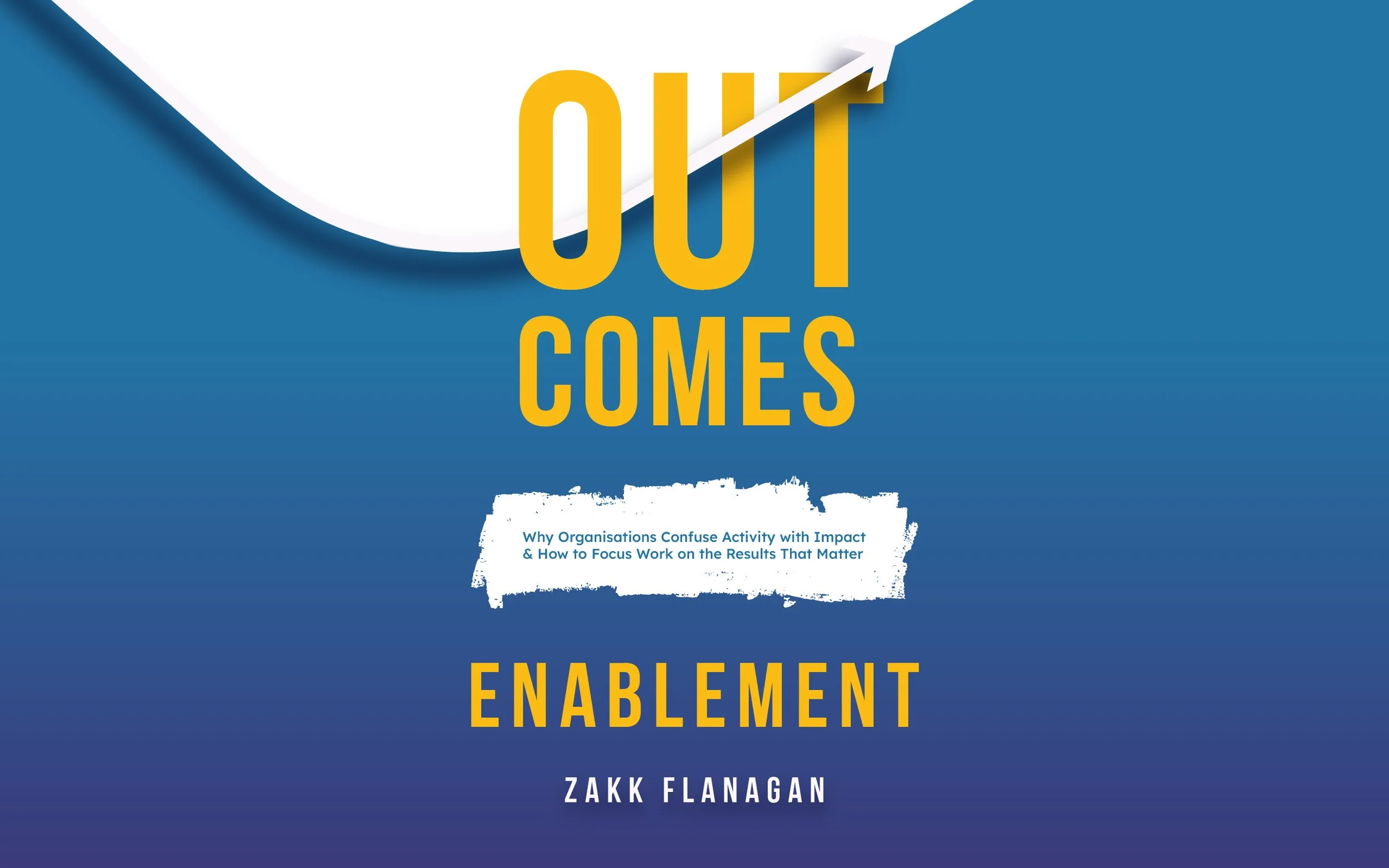
Workshops and speaking
The discipline in a day
For leadership teams, executive away-days, sector conferences and board development programmes.
What you'll notice: the conversation in the room changes within the first hour. People stop describing what they do and start asking what it's actually changing, and for whom.
You get: a half-day or full-day session, or a keynote, built on Outcomes Enablement, with the book available as pre-reading or follow-up.
Price available on request.
-
A facilitated session that takes a leadership team through the full Outcomes Enablement argument, from diagnosing the activity trap to asking the upstream question to defining the primary condition for their own organisation.
It works as a standalone session for a leadership team wanting to explore the discipline before committing to a full engagement. It also works as a keynote or conference session for sector forums, regulatory bodies and leadership development programmes.
Where to start
If you're starting something new, start with Clarity. If something's already stuck, start with the reset. Not sure? The five-minute assessment shows where the gap is largest.